THE KEY ANSWER
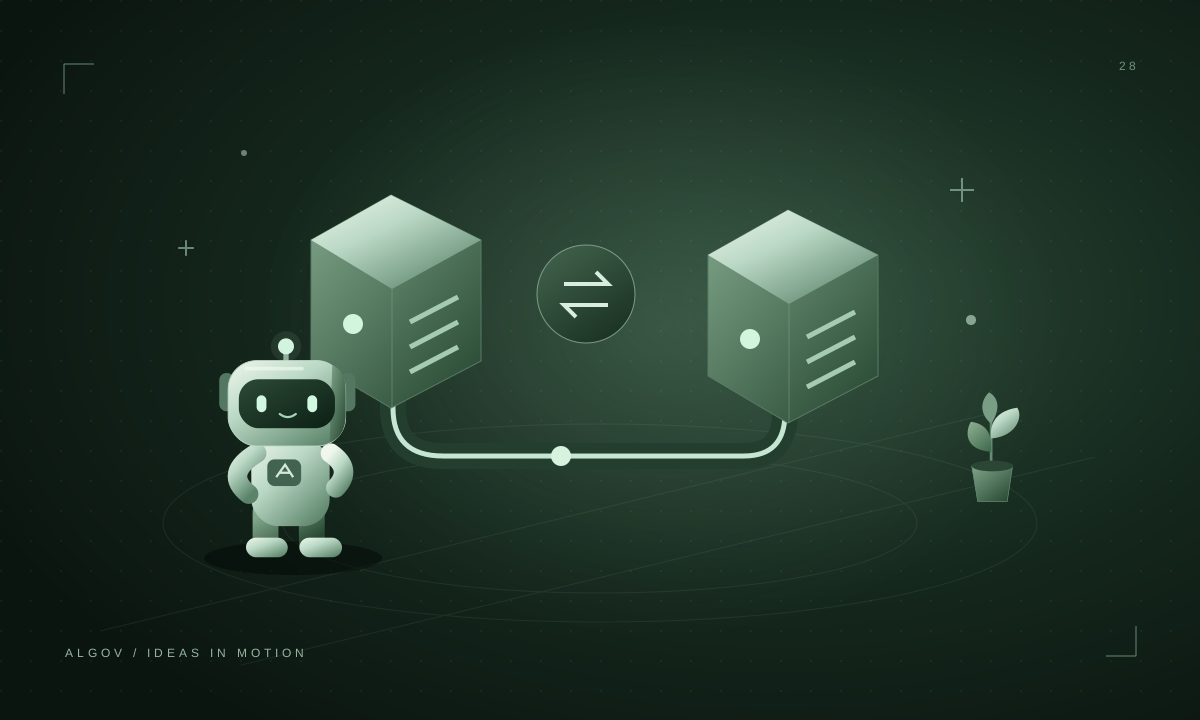
The Model Context Protocol is a communication standard between an AI application and servers providing tools and data. It facilitates the reuse of integrations. The application must still decide what is allowed to be executed and in which process.
What does MCP standardize?
MCP describes how an application collaborates with external capabilities. From a company's perspective, this may mean providing search in a catalog, retrieving case status, or preparing a draft in a system. A common interface reduces the need to build a separate connection for each AI client.
Do not confuse the information exchange standard with a complete product architecture. You still need to define user identity, data scope, approval rules, and behavior during failures. Official MCP documentation separates communication from how the application organizes the model's work. Therefore, simply adding a server does not create a ready-made, secure process.
Context and references: Model Context Protocol: Architecture overview
How to choose the first tools?
Start with a small set of operations with a clear purpose. “Retrieve order status” is easier to control than a generic “execute database query.” Describe required parameters, possible errors, and the result format. Return only as much data as is needed for the task, without attaching the entire customer profile just in case.
Demonstration example: a sales assistant can check availability and prepare an order draft. Approving the price and sending the order are separate operations. This division helps limit permissions, build a preview, and demonstrate which action actually occurred. Do not rely solely on the tool description for these boundaries.
Where do integration problems arise?
The same identifier may mean different things in CRM and ERP. Data may be delayed, and a tool may be temporarily unavailable. MCP does not automatically resolve these differences. You need concept mapping, data validation, and a rule indicating the authoritative system in case of conflict.
Also test the re-execution of operations. If a response does not arrive, the application does not always know if the save was successful. It should check the result instead of blindly creating a second record. For tools that modify data, plan operation identification and execution history. Standard transport does not remove responsibility for business consequences.
When is MCP worth investing in?
The most sense appears when several applications or teams need to benefit from the same capabilities. In a single, simple workflow, a direct API may be sufficient. Consider who will maintain the interface and how changes will be introduced so as not to disrupt consumers' work.
In acceptance testing, check user access, incorrect parameters, missing target systems, and revoked permissions. Verify read and write operations separately. Document the version of the standard used, as the ecosystem is still evolving. A good design should be able to change the AI client without rewriting pricing, access, and approval rules.
WHERE TO START
Bring this into your project.
- Expose small operations with a clearly defined purpose.
- Enforce permissions outside the model.
- Handle data conflicts and write retries.
- Record the interface version and the maintenance owner.
Choose one thing your process is missing today. It's a useful topic for your first conversation with the team.
QUESTIONS AND ANSWERS
Frequently asked questions.
Does MCP replace APIs?
Most often, it is a layer that uses existing APIs or other sources. It standardizes access for AI applications but does not eliminate the need to maintain the business system interface.
Is every MCP server secure?
No. The communication standard is not a trust assessment of a specific implementation. Before connecting, check the origin, access scope, data handling method, and the operations the server can perform.
Sources and context
- Model Context Protocol: Architecture overview ↗
The documentation describes hosts, clients, and servers, as well as the exposure of tools, resources, and prompts. It also indicates that MCP does not impose on the application a way of managing context.
Prepared by the ALGOV team. Current as of September 8, 2026. Examples describe possible scenarios, not results from client projects. How we create our guides.