THE KEY ANSWER
Start modernization with a specific business constraint and securing current behavior. Isolate areas gradually, controlling data and the ability to roll back. Treat AI as an aid in analysis, not a guarantee of migration correctness.
Diagnose the problem before choosing a new stack
Is the system hard to develop, does it run too slowly, or are there no people capable of maintaining it? Each problem may require a different answer. A new framework will not automatically fix unclear business rules. Collect examples of changes that recently cost too much and identify their causes.
Map the main flows, dependencies, and data storage locations. Determine which modules are stable and rarely changed. They do not need to be the first target for reconstruction. Choose a fragment where improvement will yield a noticeable effect, and where boundaries allow it to be separated from the rest without opening up all problems at once.
Context and references: Martin Fowler: Original Strangler Fig Application
Behavior first, then new implementation
Older systems often store rules that are not in the documentation. Collect examples of inputs and expected outputs, especially exceptions known only to experienced users. Check reports, rounding, statuses, and temporal dependencies. The test should protect essential behavior, not every accidental detail of the old code.
AI can help describe modules and search for connections, but such explanations must be compared with the system's execution. A model may miss a condition hidden elsewhere. Prepare acceptance criteria with the person responsible for the process. Without them, it is easy to “simplify” an exception on which the settlement of an important client depends.
Isolate fragments that can be switched
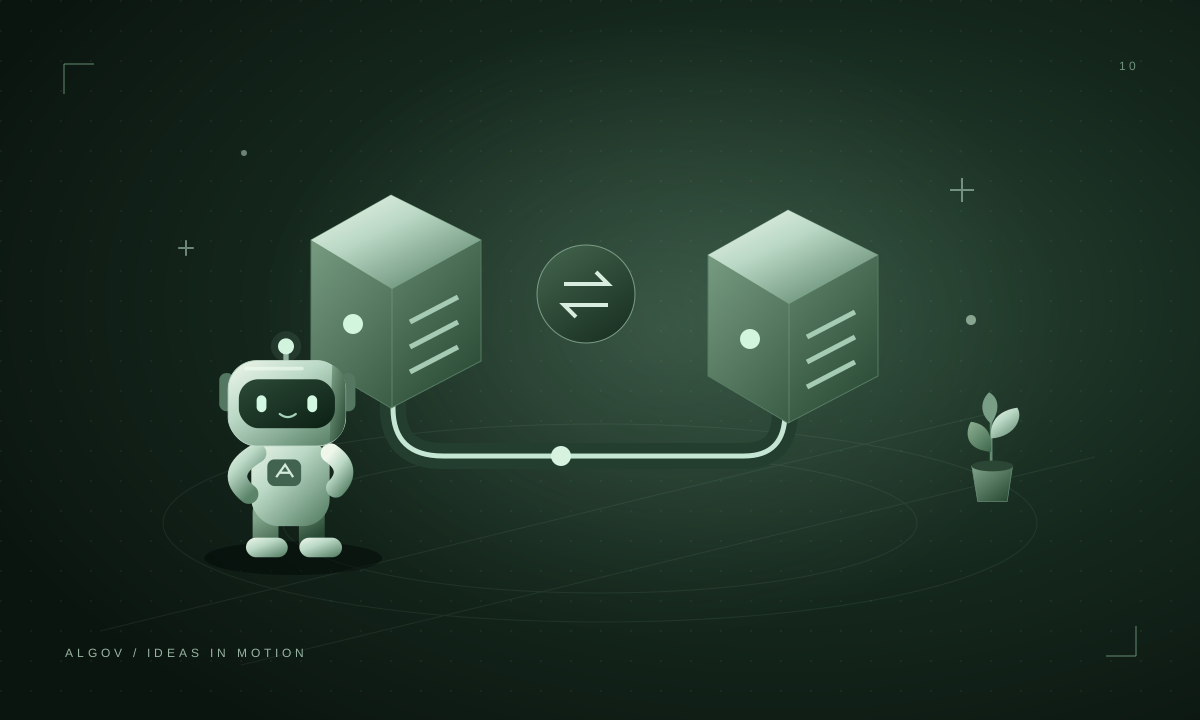
Gradual migration allows replacing selected functions while the old system is running. However, you need a clear boundary and knowledge of which variant is responsible for the write. Two systems simultaneously modifying the same data may create more difficult problems than those the modernization was meant to solve.
Demonstration example: a new module handles order placement for one customer segment, while the remaining traffic goes to the existing solution. You compare results and monitor errors. Before expanding, you check data consistency and integration behavior. The stage should be evaluable and completable independently of the entire multi-month roadmap.
Rollback requires a plan for data
Removing code does not always reverse the effects of operations performed by the new module. Determine how the old solution will read new records and what to do with partially processed cases. Practice the migration on a copy with a representative structure. Measure operation time and prepare a way to verify completeness.
After each stage, remove unnecessary transitional mechanisms once the agreed observation period has passed. Otherwise, gradual modernization may leave two systems permanently. Success is lower change cost and stable process handling, not the number of files rewritten to a new technology.
WHERE TO START
Bring this into your project.
- Link modernization to a visible constraint.
- Secure key rules with examples and tests.
- Establish one system responsible for a given write.
- Practice migration and rollback along with data.
Choose one thing your process is missing today. It's a useful topic for your first conversation with the team.
QUESTIONS AND ANSWERS
Frequently asked questions.
Is it ever worth rewriting everything?
Yes, but it requires strong justification and risk control. A small system with simple rules is a different situation than a platform with multi-year integrations. Compare the cost of migration, maintaining two versions, and the pause in development.
Can AI perform the migration independently?
It can support analysis and preparation of changes. However, acceptance must cover behavior, data, and integrations. Correct code execution does not prove the consistency of the entire business process.
Sources and context
- Martin Fowler: Original Strangler Fig Application ↗
The pattern describes the gradual replacement of an existing system. The order migration scenario and the checklist are an original development.
Prepared by the ALGOV team. Current as of September 8, 2026. Examples describe possible scenarios, not results from client projects. How we create our guides.